I came through Johor Bahru a number of times on my trip. The first after I accidentally came over the Tuas Checkpoint into Malaysia (failing to get my carnet stamped on entry) and stopped at a 7-Eleven to get some directions through driving rain to Mersing. The second, the next day, I came back from Mersing to Johor Bahru to the Malaysian Customs complex to get my carnet stamped as required.
Unfortunately, I got myself very lost in Johor Bahru and unable to get to any of the sights I had intended, like the Sultan Abu Bakar Museum and the Arulmigu Sri Rajakaliamman Glass Temple, among other temples in the area. I had also intended to get a look at the South China Sea, but the chaos and my poor navigation left little time in my day before I had to get to Melaka, so I got to wonder in amazement at the city, stopping only to turn around or ask for directions.
I stopped at Johor Bahru for a few days toward the end of my trip before heading north again to Penang as I waited for a contract to come through that would have seen me in Singapore and back to Australia promptly, but it didn't come through that week (or, indeed, the next). This time, while I waited, I took some time to travel out to Desaru Beach after being told it would only be 20 minutes drive. Even on my maps before I left it looked more like an our and a half, but I am in it for the ride as well, so an hour and a half did not daunt me. The weather tried to.
Desaru Beach, Johor - looking North West
The drive to Desaru Beach, interrupted only by toll plaza and a stop for fuel, took just over an hour but the brown signposts were easy to follow. The bridge across the Sungai Johor (Johor River) is impressive and rose up from the plantations a good distance before it towered over me across some of the cleanest water I had seen in Malaysia. The small road out to the beach itself had a fair amount of traffic on it - almost as much as the highway, and the Public Beach was difficult to find among the private resort beaches, but my MYR$1 handed to the parking security was well spent - my motorcycle was there when I got back.
Desaru Beach, Johor - looking North East
While I walked up and down the beach, a young man carrying a small round faced little girl talked to me. He is in the photo above on the right. A local from Bandar Penawar, he had been in the area all his life and spoke with a lisp, which made his stilted English very difficult to understand. He offered me a meal with his family and although I gracefully refused initially, he insisted and so I sat down with a family of about a dozen from grandparent to babies for a talk. No one else in the group seemed to speak English, so the young man tried to translate with his speech impediment making the entire experience surreal and quite challenging at times.
Desaru Beach, Johor - looking South East
The grandmother gave me a bowl of something that I think was a local laksa - a fishy broth with noodles and other things that were unrecognisable and did not translate. It tasted great, if a little hot, but I ate every mouthful to the joy of the family who asked me many questions about myself, my trip and Australia. We even spoke of politics in the local area briefly before the grandmother explained that talking politics in Malaysia was like undressing in front of a stranger - an interesting analogy, but I didn't push it any further.
They also pointed out to me that I was the only white guy on the beach, which I had not even noticed, but they were correct. The young man told me that it was an honour for his family to have hosted a foreigner and that many of the other local families were jealous of them. They would not accept any reimbursement for lunch. The trip back, much faster as I knew the roads and pushed the speed up a little more into the 130kph, I was stopped briefly by a police roadblock but waived through when they saw I was Australian.
I came back later when I was heading home to Australia and tried to get to the museum (which was under renovations and inaccessible to tourists) and the glass temple (which I tried to navigate to for several hours, but finally gave up only to see it on the opposite side of the road with no way to turn around). I will have to make another attempt to see these the next time I pass through, perhaps in October.
Kuala Lumpur is a cyberpunk city, mixing incredible clusters of buildings with affluence and massive infrastructure that creaks under the strain while ramshackle buildings lean against each other in the shadows of impressive architecture, like the Petronis Twin Towers.
Night skyline showing Petronis Twin Towers
I first drove in to Kuala Lumpur from Kuantan and could see the smog and haze as I approached, obscuring the city skyline until I came quite close, but then out from the grey familiar landmarks appeared. Even before I arrived in the city, I recognised the towers.
An example of a good day with minimal haze
On my way into Kuala Lumpur, I stopped at one of the rest stops to stretch my legs and found myself the object of a bus-load of Chinese tourists who decided I was amazing and crazy to be doing my trip. They all lined up to take individual photos with me by the motorcycle, and all wanted me to put my arm around them and give a "thumbs up" signal. I joked later on my Facebook page that because I had not shaved, they might have mistaken me for Charley Boorman.
Amazing architecture with background landmarks
This comment led to talking to him two days later after being introduced to Maznah Zolkifni, an intelligent and dynamic young Malaysian actress who had also just spoken to Charley while he was in Kuala Lumpur filming his next documentary. I managed to get contact details for is producer and director and, although there had been some discussion (when I had been mistaken as a local journalist) that I might meet him, a massive downpour of rain that he had been riding in meant that he really just wanted to relax and get back to his hotel. Having been caught in a similar rain attack days earlier, I really did understand, so instead, we spoke for about 15 minutes on the phone. It was the most rewarding experiences of Kuala Lumpur and a real buzz to talk to the legend.
I drove through Kuala Lumpur several times and got lost almost every single one. The GPS was no help at all as it did not differentiate between the upper or lower road. I found myself getting caught on the wrong one regularly. On my first entry to the city, I managed to get myself lost in Little India as a market sprang up around me blocking roads that I had initially driven down. I felt the markets growing around me and it took me a lot of effort to get myself out of the lanes shrinking like clogged arteries.
Front of the National Mosque in Kuala Lumpur
Kuala Lumpur's National Mosque
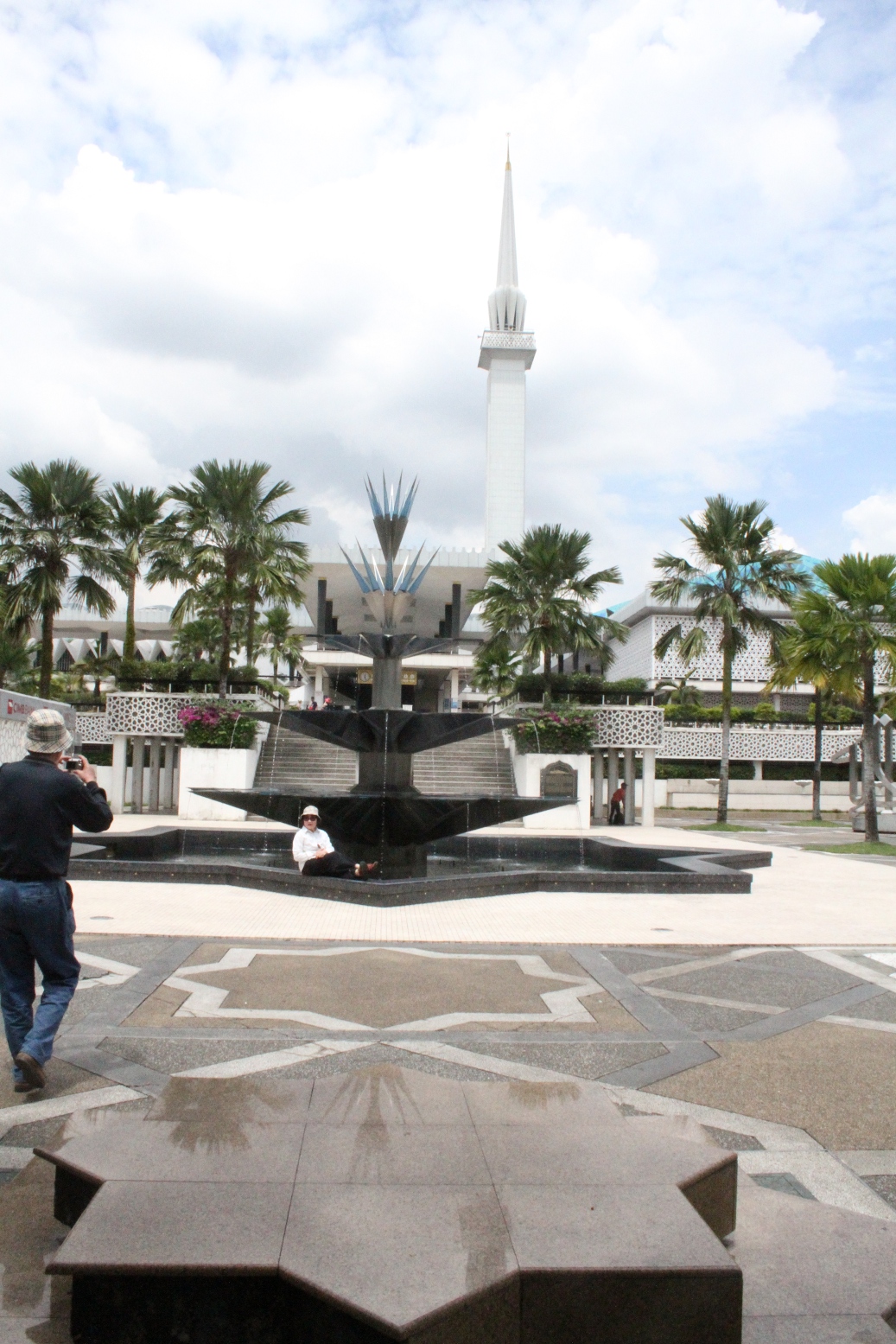
I raced out on foot one afternoon before the weather closed in to see the National Mosque, which I did not find as spectacular as the mosque in Kuantan, but it was certainly larger. I didn't get a chance to look inside as it had been closed for prayers. This seems to be the time I turn up at mosques to take a look at them, actually, at almost all temples.
Islamic Arts Museum
Instead, I found the Islamic Arts Museum with an excellent arms and armour, tapestries, calligraphy as well as a Chinese vase display. It took me some time to find the entrance, but once I figured that out, it cost only MYR$10 for as long as I wanted to roam around and look at things. Although most photography was prohibited in the museum, and the displays were incredible, the ceilings were amazing.
Roof inside the Islamic Arts Museum
Inverted dome inside the Islamic Arts Museum
On my way back from the National Mosque and the Islamic Arts Museum, I spotted some street art on the railway line. I crossed the road to take a quick photo of the spot I had found, which suggests there is probably some other stuff in Kuala Lumpur that I just didn't find. Although the image is interesting, the more exciting story is that minutes later, I had two guys on a scooter attempt to snatch the camera off my shoulder, failing miserably and ending up hurting themselves in the process.
I took with me a small Contour Roam that mounted to my motorcycle helmet. It came with two mounts, but I only even attached one to my helmet. I assumed that at some point I would probably have to replace my helmet and then I would use the second mount, but it never came to that. As a result, all of the shots are in portrait when they would probably have been much better in landscape.
Regardless, this footage is really valuable for people wanting to drive through some of the areas I have driven through. The GPS is good, don't get me wrong, but there is no Google Street View in many of these areas (although Singapore had a lot), which I use extensively in Australia when I am navigating to a new location to get an idea of what the roads are like and what sort of landmarks or road markings I should be looking out for.
I also didn't realise the size of these clips initially, both in terms of time and bytes (or should I say Gigabytes). There were times driving where twenty minutes could pass without me turning the camera off and there were certainly times when I forgot to turn it off. Finally, they are raw footage, and if you don't like them, bad luck, as they are great memories for me.
First recorded drive in Singapore
My first drive in Singapore from RAM Racing Engineering to my hotel undertaken in the dark did not have any video associated, and lucky, because not only did I go to the wrong location, I also got myself lost and drove around in a circle. Glad I had my wits about me, I noticed I had been there before, and pulled over to check the maps that RAM had printed off for me. I am so glad they did. I found the point where I turned left instead of right and just stepped through them again.
This video is the first time I drove in Singapore with the Contour Roam on and it is about 25 minutes of footage. I have left the audio as recorded. Although I am not a great speaker and I sometimes stop when I need to concentrate, it is my first footage of what it is like to drive in Singapore during the day. Some of my commentary helps to show my own thought process and might assist in both placing it geographically and pointing things out. It might also be funny to hear my brain disengage from my mouth at times, if you have never heard that (some of my friends might say this is a regular occurrence, but I beg to ding a ding dang my dang a long ling long).
This video sees me drive past the Automobile Association of Singapore headquarters on River Valley Drive (and the lovely Rosie Chan who has really helped me out with all the paperwork in getting the insurance and carnet sorted out to drive in Singapore). It also shows the relatively tame Singapore traffic, but watch out for those taxis, and the Chinese New Year set up, like the big red dragon along New Bridge Road/Eu Tong Sen Street. I find out talking in the wind does not work on this first trial.
I especially like the attempts to turn right and then left into a one-way street. This happens a few times in the early days of driving in Singapore because I have been walking down the streets and failed to really notice the traffic is only one-way. After a lot of round town hunting, I finally get to my hostel and if you watch up at minute 23 or 24, I actually forget how large the panniers are and get stuck on two concrete poles just before parking. Worth it for the laugh.
Chinese New Year
It didn't take me very long to get the itch to ride around Singapore, which is not that big. Even then, I did not stray too far as I was still getting my feet (or wheels) around both the new bike and the new country. I have a process for learning my way around places and it works on foot as well as with the bike. I go around the block a few times and get my bearings, then I extend the block to two blocks, then three. If I have a map, I head off in a direction for twice the time I have taken to explore around three blocks, then try to find my way back, using landmarks and skyline to navigate.
This is what I did on the first day of Chinese New Year, but several streets had been blocked off for the celebrations and I didn't really count on how many one-way streets or how few u-turns were available. This meant that if I tried to duck down a side street to turn around, I found it was one-way (for better or worse).
I had been parking my motorcycle in a paid parking location directly opposite my hostel (Beary Best) on Upper Cross Street. I had my camera on the helmet, just in case, but once I rode down the street and saw the spectacle unfold in front of me, I had to turn the camera on. This shows me initially on Upper Cross Street and approaching the corner of Upper Cross and New Bridge Road/Eu Tong Sen Street. From what I could gather (and I could be wrong) New Bridge is one side of the street, and Eu Tong Sen is the other side. This stumped for some time and I am still unsure if it is correct. It seems that the locals consider this two separate carriage-ways, but for me it seemed that one side had a different name to the other side.
This clip shows South Bridge Road down to Neil Road during the high point right before the first night of Chinese New Year celebrations, past the Sri Mariamman Temple and the Buddha Tooth Relic and Museum. It also shows you how packed it can get before the celebrations and how many people are roaming around.
Gardens by the Bay
The Gardens by the Bay at Marina South were very hot and humid during the day, but once I got the bike, I could roam a bit more on my own and so, on Chinese New Year Eve, I decided to get away from the traffic around Chinatown and head across to the Gardens by the Bay to take a look at them at night.
This clip shows me heading out to Marina South Park, starting on Central Boulevard and turning into Marina Station Road, then Marina Street, Marina Place, Marina Boulevard, and finally into Marina Park and the Gardens by the Bay. The second clip, below, shows parking at the park.
Not going to Sentosa
No one told me that motorcycles aren't allowed on Sentosa. I had heard about how glorious the place is and the magnificent beaches. It also has the resorts and Universal Studios theme parks, but I was not overly interested in seeing them. I decided on the morning after the first night of Chinese New Year celebrations to head over to see for myself.
This footage shows what happens when you take the left fork in the road once you are across the bridge to Sentosa. I realised I could not skip lanes, so thought I would ride it out, not stopping and just doing a loop around to find that you have to go back across the bridge to turn around and try again. I wondered why the security were waving me through - because unauthorised motorcycles are not allowed on Sentosa Island.
This clip shows what happens if you take the right fork in the road once you are passed the bridge, but it doesn't show you much else as I was turned around quick smart. No unauthorised motorcycles are allowed on Sentosa, which is a shame because I decided from that point that I would not bother seeing the island if I couldn't do it on motorcycle. I am a responsible rider and don't see why I should be penalised because of the scooter punks. Maybe they should just ban scooters.
Kong Meng San Phor Kark See Monastery
After being turned back from Sentosa, I travelled to the Kong Meng San Phor Kark See Monastery on the day after Chinese New Year celebrations started, not knowing this is a traditional time for Buddhists to visit the monastery. Initially, I thought there must have been an accident on the road ahead, but as I approached at a snails pace, I realised the monastery was the cause of the traffic.
Next clip, showing my ignorance, is where I realise it is a Buddhist Monastery. For some reason, I never bothered to find out before I turned up and then I seemed to be surprised that it was Buddhist.
The parking was incredible and on repeated occasions I was directed to ride on the footpath or around cars, but I was still new in Asia and not quite used to the disdain for traffic rules that all other motorcycles and scooters show. The following clip shows my travel through various parts of the monastery as directed by security.
I really wanted to go and see some fauna that I have never seen before. I had planned on heading to Taman Negara to see if I could see anything in the wild, but I also planned to support some of the conservation and sanctuaries for sick and injured animals, like the Kuala Gandah Elephant Conservation Sanctuary. This place is incredible and the guides and elephants are very friendly.
Welcome sign to the Conservation Sanctuary
Not knowing much about elephants and only ever seeing them at a zoo at a distance, I really didn't quite understand how awesome their mass actually is. They are big and heavy and they can make very loud sounds. They are also very smart and seem to really try to communicate.
Baby elephant at the holding pen
I got there on a Friday, which due to the Muslim holy day, is a little quieter than normal and only has a feeding activity at about 2.45pm (check the times before you take my word for this). I knew it would be quiet, which is why I picked this day and drove from Kuala Lumpur. It is relatively easy to find and marked well by Tourism Malaysia (watch for the brown signs). The 9km road out there from the highway is a really nice forested and cool drive, but beware of the local traffic, chickens, dogs, and children running across the road. Also be aware that the road is not very wide and oncoming traffic can cause some issues, although this is minimised with a motorcycle.
On arriving you need to check yourself in and register at the visitor information centre before you cross the bridge and into the sanctuary itself. This is to ensure that you are informed about what you can and cannot do, and any safety information you need to know. It is also to keep track of the numbers of people going into the conservation area to maintain it and the elephants state of mind - there is a quota.
Real elephant skeleton on display at the registration centre
This is also the place you can make donations and unlike the temples, there is no donation box sitting around. If you want to make a donation, you need to see the registration staff. It costs about MYD$100 a day to feed a single elephant, so I'd recommend this as a starting donation as there are quite a few on the conservation and they eat about 200kgs of food daily. They are vegetarian and banana trees themselves make good food, which is why they can become a problem for farmers.
At the registration centre is a display room and a theatre which shows videos on how the elephants are translocated from areas of danger or concern to places like the conservation and Tanam Negara. The video was quite educational as I always thought of elephants as relatively docile creatures, but they are clearly difficult to manage.
In fact, there were lots of things I didn't know about elephants that I learned while being here. I didn't realise that Elephants have a similar life expectancy to humans and some have lived to be as old as 80 years in good environments that mimic their real wild environments. They have 4 teeth (tusks are not teeth) that are replaced up to 6 times as they loose them throughout their life and once their teeth are all gone, they die - usually because they can no longer eat. They are also very susceptible to trauma and just the traumatic experience of being moved somewhere can be enough to kill an elephant.
Part of the trauma issue is that they have really good memories. I have seen a documentary on their burial practices and that, in their native environment, they return to the burial grounds every year to pay respect to the dead. I have also heard that they are on the same level as primates for intelligence and tool use. They also make many more different noises than just a trumpeting sound, which is damn scary when they let forth a trumpet near you. They also have clicks, whistles and this deep grumble that reminds me of the crocodile rattle. There is even one instance of an elephant (Kosik) using its trunk inside its mouth to articulate Korean words. Eat your heart out Washoe!
I'd recommend you pay the MYD$50 for a guide to take you around the sanctuary. If anything it will keep you from getting zapped by electric fences, attacked by snakes and large spiders, and they carry a beating stick for anything larger - and apparently there are tigers on the sanctuary but they are well fed. I was afraid to ask what they were eating since they don't eat the elephants or humans (at least not that I heard). You can also get a guide for the Malaysian aboriginal community up the hill from the reservation centre to support them.
My guide, a pleasant and informative lady named Azmira, led me around the sanctuary and introduced me to the elephants, answering my many questions about various aspects and giving me some great general and specific information. First, we went to see the young ones and feed them some sugar cane and banana - I got to pat an elephant, hold the trunk, and pat its tongue (which was very warm). Then we went for a walk through the forest area and her and another guide showed me some of the bush medicine and poisons native to the area. Finally, after the video, she took me up to see the aboriginal community and the traditional house structures before getting me back in time for the adult elephant show and feeding session.
Greedy elephant who wanted more of everything
I had a brilliant day with the elephants and seeing the native Che' wong Orang Asli community. I'd recommend if you find yourself in Kuala Lumpur or even in Kuantan to take the effort to get out of the city and go and take a look at this marvellous sanctuary and lend some support to the efforts to keep them going.
My first experience driving in Malaysia was painful - driving rain, pitch darkness, limited visibility. I didn't know where I was going, my GPS was out, and I was getting dazzled by lights from incoming vehicles. I have driven in Australia around kangaroo and cattle zones, so the warnings to beware of the cattle were nothing special, but the warnings to watch for elephants really had me a little worried. I decided it must have been a joke.
I found out a little later that Johor has a significant population of elephants and they do sometimes cross the roads there, so if you see a warning about crossing elephants, take it seriously. I have no doubt an elephant would make a mess of your car, but riding a motorcycle, I'd probably have to have my body surgically removed from the elephant, even if I survived and this just doesn't sound pleasant at all.
The weather in the period I have been in Malaysia (mid to late February) has been quite wet, but reliably so. You can pretty much guarantee that mornings and early afternoons will be cloudless or a little overcast, but will not rain. There is a rain period from about 3pm through to about 7 or 8pm when it clears up and, as a friend told me (and I didn't really believe him) if it is not raining at about 9pm then the night will be clear of rain for some time. There can also be a midnight rain period that lasts until just before dawn.
The ultra-violet is severe here, like it is in Australia, but the sunlight is a little less bright, so you don't quite expect it. I have had some excellent sunburn just riding around in the mornings with normal jackets and gloves on. One day, I went for a long ride to a local beach (about 2 hours return) and on the trip out my sleeves blew out leaving an inch gap between my shirt and gloves. This resulted in a wonderful red wrist band that was sore for days. I also got a lot of sunburn on my neck due to the high UV and lack of cover on this area.
I have made a lot of use of these tubes of fabric that are placed over your head under the helmet and pulled down to cover the neck. They are also really useful for keeping dust out of your nose and mouth. This is not a big problem in Australia, but Malaysia has a lot of particulate debris on the roads from dust and dirt to grit and pulverised bits of plant and leaf. It is easy to inhale this on the road, so having a cloth over your mouth and nose will save you a lot of unsavoury experiences.
As for roads, the major highways are pretty well maintained and the speed limits are set at 110kph when you are outside a city limit and at 90kph when you are close to a city. Sometimes if the highway takes you through a city, it might drop down to 70kph (or even 50kph) when there is entering or exiting traffic.
I was told by other riders in the area as a motorcycle, I would have no problems travelling at 130 or 140kph in the 110kph zones and at first, I didn't really believe this. After being hassled by scooters sitting on my arse at 100kph in a 90kph zone and watching some of the larger bikes fly past me while I was doing 120kph in a 110kph zone, I decided to crank it up (safely). On a specific stretch from Kuala Lumpur to Johor Bahru, I had the bike up to 140kph in a 110kph zone and a police car passed me (much faster) waving and smiling. I have been able to get the bike up to in excess of 160kph in a 110kph zone with no trouble at all and the roads are good enough to handle it. However, note that the legal limit it signed well and you take a risk exceeding that limit.
The smaller roads will not handle this speed and you would be crazy to try. Both the state of the roads and the amount of slow traffic would be prohibitive at best and deadly at worst. Many of the country roads into the jungle areas are not signposted with tight corners and you find even at 80kph (in an 80kph zone) it can be difficult negotiating these corners as they come up on you from out of nowhere with no warning. Additionally, some of these old roads have some wicked dips in them and I got airborne on one doing 60kph which had me a bit worried. There is also no way to overtake if you get stuck behind a slow moving vehicle on these roads and it is often very dangerous to try.
On the larger roads, there is a shoulder that becomes a default motorcycle lane for the scooters and smaller bikes. For most cars, they expect that all motorcycles should be in this non-lane, but the edge of the road is not a place to be doing much more than 100kph and I would consider that speed in that lane is dangerous. That section of the road is not maintained as well as the main road, and there is often debris over it, like gravel, branches, and road-kill. I started trying to stick with all the others in the left lane, but as soon as you are on a big bike and travelling faster than 100kph, it is almost suicidal to stay there. You are also in a big blind spot for many normal road scenarios.
It is also expected that you as a motorcycle will relinquish your lane to anything larger than you if it approaches at speed behind you, even if you have nowhere to go. It is expected you will pull over to the left and the vehicle will pass very close with no indicator on your right. The vehicle behind will sometimes flash lights or use their own indicators to urge you out of the way. As a courtesy, in Australia, you stay left unless overtaking, but in Malaysia even if the right lane is clear, you will need to pull to the left while in the left lane to give another vehicle space to get past you. It doesn't matter if the right lane is vacant and they could move into the right lane to get around you; you, as a motorcycle, are expected to get out of the way to anything larger behind you.
Staying to the left is also useful for the toll plaza that seem to arrive randomly as far as I can see. When I got into Malaysia from Singapore, I had to get a "Touch and Go" card for USD$34 (which I found out later was a lot more than it needed to be). This card is used at the toll points for cars, but the only toll point I have had to use it with for a motorcycle was the one when I entered Malaysia from Singapore. Every other toll point has a small motorcycle lane at the far left just large enough for a motorcycle to move through.
Some of these motorcycle toll lanes are simply a small lane right next to the car lanes with no toll gate. Others are intricate weaving lanes that move around the toll area, with motorcycle parking and different single lanes disappearing off into other directions. There were even a few that had an over and under pass area for motorcycles. I always took the direct route as I was never sure where the other routes led. The idea, though, is to keep your speed down and that is why they are designed to be quite narrow and meander around the place.
Night time riding can be quite dangerous because the roads are not well lit and their seems to be no courtesy about turning down the high beam for oncoming vehicles. I was told that there is a general courtesy to turn high beam down, but that the lights themselves are often not adjusted to focus on the road properly and many focus high, which looks like high beam glaring in your face rather than being focused on the road. Regardless, in rain this can be devastating and I have refrained from driving at night since that first night ride to Mersing.
Walking up the Batu Cave steps to the Temple Cave, I made sure when I started to feel fatigued that I concentrated on where I was putting my feet. The photo below was an exchange with another solo tourist who wanted a photo like this with her in it, so we negotiated an agreement. If you look in the background to the right, you will see two guys in the process of being mugged by monkeys. This was a smart phone snatch and the guy in the black shirt lost his latest edition iPhone because he held it out to take a photo of a monkey who decided it was an offering, snatching it and running.
Nearly to the top (Pic exchange with another solo tourist)
Only a few more steps, surely
Getting to the top, you assume that there are no more stairs, but you are very wrong. The Temple Cave complex is vast and much larger than I expected before I got there. The caves themselves are amazing structures, but the amount of space is impressive as are the shrines and temples built inside. I had a few monkeys approach to see if they could steal anything, but I think my helmet put them off as it was latched to my belt and looked like a face watching my rear.
Welcome to the cave entrance
More steps, both down and up
The temperature drops significantly once in the shadow of the caves. Although there are no more banana stalls from this point, there are many tourist shops, even selling little die cast Petronis Twin Tower replicas and "I love Batu Cave" bumper stickers. They also sell drinks in these stalls, so if you have run out of water you can grab more here.
One of the many shrines inside the Temple Cave complex
There are dozens of detailed shrines and temples inside the cave complex, some are off-limits and some are being repaired, but many are open to the public to pray at or take photos of. The detail in the work is amazing and I found myself happily snapping away just because they were incredible works of art, not just religious in nature. I was a bit disappointed with the Main Temple after such incredible build up outside and the size and scope of the cave itself. I was imagining a massive and intricate temple hidden in the caves.
Batu Caves Main Temple
Batu Caves Main Temple
It seemed that there were no more monkeys this far into the cave complex, but I was wrong. Looking back the way I had come, the caves themselves were still impressive and quite large, but as mentioned above, I was expecting more inside the caves than there was. Maybe the caves themselves were so revered that to build anything inside them really needed to have a good reason.
Also be aware, even though there are signs everywhere, you need to remove your shoes if you are going to enter the temples. I watched a tourist from one of the Eastern European countries fail to read the signs and she was monstered by one of the monks who told her in crisp English to remove her shoes. She continued as if she didn't understand and he had to physically walk her out. Then she started to remove them where she stood and he had to point to the signs for her to figure out she was still too close. The signs really are quite obvious, so I don't know what she thought she was doing.
Looking back toward the entrance to the caves
The large temple at the far point in the Batu Caves
There are more temples and shrines at the far point of the cave so don't just stop at the Main Temple and think you have seen it all. It is still worth heading up the final set of stairs to see the back of the cave. This is also where the more peaceful monkeys are and the only place I saw the little baby monkeys, clinging to Mum with big bright eyes. Many of them were not happy to have their photos taken, but they were not as aggressive as those out the front of the cave complex, which I thought was a little strange as they had young to protect.
I exchanged my saved banana to get close to this Mum and baby
Many of the tourists were trying to get close to the babies and the mothers would just take them higher into the caves to get them away. I remembered then that I still had two banana in my backpack, stashed for an emergency like this one. Wary that these monkeys are not stupid and often cannot be cajoled into doing anything, I thought that just offering two bananas would be a nice thing to do as the guys out the front were clearly not bringing any bananas into these depths for the young.
She hissed at anyone else who got close, but I was favoured
Initially, I pulled them out and some of the younger monkeys came up to me intending to mug me, but they soon found out I was wise to them and when they couldn't get behind me or form a pack, they relaxed a little. I moved as close as I could to the Mum and baby I could find within throw range and threw my first banana at them. Mum realised it was for her and the other monkeys also knew it was for her, so they let her come forward to collect it. She still wouldn't let me hand her the second banana, but she checked it was suitable and then gave the remains to the baby who munched it down.
The choice photo, contemplative and caring
I threw the second banana a little closer and she knew I wanted her to come closer so I could get a photo. Once the second banana had been devoured, she considered my request and then clambered down onto the stairs for some close photos. She hissed at the other photographers if they came closer than I was, clearly understanding the trade we were making. I was able to get about four meters closer than any of the other photographers and took some great shots of the couple.
This was probably my highlight of the day. The caves were amazing and the temples were detailed and beautiful, but the interaction with the monkeys was the most fun. They are not stupid - in fact, I think I saw much more stupidity from the "higher" monkeys. They were often outsmarted by the "lessor" monkeys. There is such a curiosity and intelligence in these eyes that I think we humans sometimes forget that we are not the only sentient creatures on this planet.
I took advantage of the good morning weather in Kuala Lumpur to get to the places I wanted to see. One of the primary locations I had been recommend were the Batu Caves. A friend had told me to get some bananas at the bottom of the caves and take them up into the caves, which is what I planned to do, unaware that my friend had tried to set me up for a monkey mugging, but I'll get to that a little bit later.
The drive from Kuala Lumpur to Batu Caves is relatively easy if you don't over think it and there is a train station right next to the cave complex. I over thought the entire thing, so was looking for the temple on the GPS and in the maps, via Google Maps, and other tourist maps I had available, but I was concerned that there is also a suburb called Batu Caves. I could not tell if I were just being guided to the suburb or the temple complex. In the end, I placed my trust in Tourism Malaysia as I had seen signs to Batu Caves on my way into Kuala Lumpur from Kuantan. It took me only a short time to find these signs again.
When facing the complex, to the extreme left is the Ramayana Cave which holds a range of Hindu statues and pleasant lighting, but when I arrived, the large warning signs out the front and the restricted access put me off going in as it looked like it was being renovated. No one else went anywhere near it and even when I spoke to the guys at the Hanuman Temple, they could not tell me if the cave was open or closed for work. I had not yet seen the arrogance and ignorance of many of the Western (and Chinese) tourists on site, so I refrained from investigating for fear of insulting someone or causing trouble.
50 foot tall figure of Hanuman
Hanuman, the monkey trickster and Hindu deity, was the first temple I stopped at and probably appropriately warned me of what I was in for later. You know who your real friends are - those who try to catch you out when you are a tourist in a foreign country so they can get the good stories. I watched a guy try to get a monkey to take the photo he wanted by bribing it with a banana, but it didn't go well. He thought the monkey he was facing was the only monkey he had to deal with, but within minutes, he was swamped by a pack of about a dozen who clambered all over him to get the single banana. At first, I thought about helping him, but he was with a group of friends who were being no help at all and I left them to figure it out themselves.
One of the things I have learnt while travelling is not to get involved if you can help it.
Approach to the Art Gallery Cave and Museum Cave
I had all good intentions to see the other caves and investigate what was in them, but I wasn't really interested in watching dances or listen to chanting. Intellectually, I find these things interesting, but I really wanted to get up into the main cave to take a look. The Entrance Shrine was gorgeous to look at, but when I was there I didn't get too close as they were hosing the place down and I didn't want to get wet (although with the temperature, I understood why these guys were hosing things down and walking around in robes just covering bottom halves).
Entrance Shrine at Batu Caves
To the right of this image is a fortified store with banana and coconuts available for purchase, but they don't look the normal quality of fruits here in Malaysia and the guard out the front is not there to watch for people. The monkey's make sly passes every now and then and the guard is keeping his eye on them. There are no warnings anywhere for the tourists, but I was already watching those monkeys with wariness. They were also keeping a watchful eye on me.
One of the monkey muggers sounding me out
I purchased a bunch of bananas on a pink cord and asked the guy at the stall what the safest way to carry them was. He shrugged and told me to tie them to my belt, but I am pretty good at noticing those furtive glances between guards and the locals smiles. When the monkeys weren't looking, I stuffed two banana deep into my backpack and put the rest of the bunch in an external pouch in my backpack - out of view, I thought, but perhaps not realising their sniffing skills.
I moved toward the entrance to the Temple Cave and the impressive red and white painted stairway only to realise I was being followed. Perhaps tracked and herded would be more appropriate terms. I had a pack of monkeys, convinced I had bananas, trying to get behind me, but my martial arts multiple attacker sparring training came in handy and I was able to divest myself of the bunch of bananas quickly while sparing myself the monkey mugging I got to see happen around the place to less well trained tourists.
I wasn't stupid enough to try to give them courteously to the monkeys either - I threw them off into the distance for the monkeys to chase. I dropped one at my feet and backed off and when the bunch was complete (except the two I had stashed) I made a big show of being very sorry I had no more and put the last bits in a bin nearby. Like pretending to pick up a stone and throw it at a pack of dogs (of which there was a pack in the car park I had to tend to later), the monkeys were fooled and assumed they had got all I had.
At this point, I am noticing that an English couple are under attack a hundred meters away by about twenty of the monkeys, who had climbed onto the girl and were looting the bananas from her. She was bleeding as they dug their claws into her to hold on. Her clothes were not tough enough to stop them and when the guy moved to rescue her, several of them bared sharp teeth and then jumped on him as well. I decided I had come off reasonably well and cursed my friend for not warning me. On the other hand, I would probably have done the same to him, so I figured this made us even.
Entrance to the Temple Cave
140 foot statue of Lord Murugan (the worlds tallest)
The statue of Lord Murugan is impressive and can be seen from most places across the complex. You don't really get a good idea of how big it is until you are up in the temple complex itself and can look out and see the view that Murugan has over the surrounding land. I have found things always look much taller when you look down from the top rather up from the bottom.
Batu Caves stairway to heaven (all 200 plus steps)
The steps are quite narrow, but the red and white paint does help you keep a close watch on where your feet are. Many people I saw started off strongly, powering up them only to falter toward the middle section. There are three "lanes" but the middle lane had been closed for cleaning while I was there. The best thing for me was that I can walk up steps without watching my feet, so I noticed the monkey's sitting on the edges watching the tourists with some serious anticipation. I chose to remain in the centre of the stairway on the way up, avoiding what I was to witness along the way.
Monkey waiting to grab something from someone on the way past
This monkey waited looking cute and allowing photos until a girl got too close and then he stole her hair clip and ran off with it. Others, also posing for photographs, were spotters for the tourists who had made it this far with food. What the tourists failed to see were the other dozen monkeys on the outside of the wall waiting in silence for the sign to attack. While I walked up these steps I got to see a dozen monkey muggings and they didn't just steal food. I watched one take a guys watch while he tried to take a photo of a monkey. Another snatched a mobile phone and another acted as a diversion while a tourist's pockets were searched. I had to wonder if some of them had been trained and were returning their winnings to someone in the complex.
Not at the same height, but you get the idea of how big Lord Murugan is
Pausing to turn back is not just useful to catch your breath as the view can also be breath-taking. I was not quite at the same height at the top of the Murugan statue, but it still gives a good idea of just how tall it is with the city in the background and the size of the people approaching the Temple Cave lanes as they lead to the steps.